 Skip to content

Dubai has never been a city that does things in half measures. From the world’s tallest building to the largest man-made island, the emirate has consistently redefined what is possible in urban development. Now, it is set to rewrite the rules of public transport once again. On April 22, 2026, Sheikh Mohammed bin Rashid Al Maktoum, Vice President and Prime Minister of the UAE and Ruler of Dubai, announced the Dubai Metro Gold Line — the largest transportation project in the emirate’s history — a Dh34 billion ($9.26 billion) fully underground metro line that promises to fundamentally reshape how millions of people move across this fast-growing city.
A Landmark Announcement
The Gold Line announcement came less than a year after the foundation stone was laid for the Blue Line, signaling that Dubai’s infrastructure ambitions are not slowing down — they are accelerating. In a social media post following the announcement, Sheikh Mohammed captured the spirit of the project in a single sentence: “Our future endeavors will not stop; rather, they will accelerate. Our plan is to build a better future for millions of people. We stand by our words and deliver on them.”
The scale of the project is hard to overstate. At Dh34 billion, it represents the single largest transport investment in Dubai’s history, surpassing previous metro expansions by a significant margin. When complete, the Gold Line will extend the Dubai Metro network from its current footprint to 162 kilometres and 85 stations — a 35 per cent increase in total network length.
What Makes the Gold Line Different?
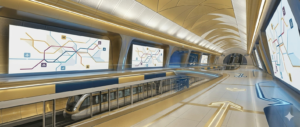
Among the most significant aspects of the Gold Line is that it will be Dubai’s first fully integrated, entirely underground metro line. Every one of its 42 kilometres will run beneath the surface, with tunnels reaching depths of up to 40 meters at certain points. This is not just an engineering choice – it is a deliberate urban planning decision.
By keeping the entire line underground, the Roads and Transport Authority (RTA) ensures that construction causes minimal disruption to Dubai’s roads, existing developments, and daily life. The project will deploy the latest tunnel boring machine technology to achieve this, and has set an ambitious target of completing construction 30 per cent faster than the Blue Line was built. The tender for construction is expected to go out in 2026, with a contract to be awarded in 2027.
The tunnel network required for the Gold Line will be equivalent in scale to twice the total length of all existing Dubai Metro tunnels – a statistic that puts the sheer scale of this undertaking into perspective.
The Route: From Old Dubai to the New Suburbs
The Gold Line tells the story of Dubai itself – a journey from the historic heart of the city to its newest, fastest-growing residential communities on the outskirts.
The line originates at Al Ghubaiba, in the older, heritage-rich part of Dubai, and travels 42 kilometers westward before terminating at Jumeirah Golf Estates, one of the city’s premium residential and golfing communities. Along the way, it passes through 15 strategically selected areas, including Mina Rashid, City Walk, Business Bay, Mohammed Bin Rashid City, Nad Al Sheba, Meydan, Mohammed Bin Rashid Gardens, Al Barsha South, Jumeirah Village Circle (JVC), and Jumeirah Village Triangle (JVT).
These are not arbitrary stops. Together, they form a corridor connecting some of Dubai’s most densely populated, most visited, and most rapidly developing zones – areas that have historically had limited metro access and where residents have largely depended on cars or taxis.
18 Stations and Four Key Interchange Points
The Gold Line will feature 18 stations spread across its 42-kilometre route, making it one of the most densely serviced metro lines in the city. But what sets it apart from a simple point-to-point addition is how thoroughly it integrates with Dubai’s existing public transport network.
There are four major interchange points:
- Al Ghubaiba – connection with the existing Green Line of the Dubai Metro
- BurJuman – connection with both the Red Line and the Green Line
- Business Bay – connection with the Red Line
- Jumeirah Golf Estates– connection with the Red Line and, crucially, with Etihad Rail
The Etihad Rail integration deserves particular attention. At both Jumeirah Golf Estates and Meydan, the Gold Line will connect with Etihad Rail passenger stations, positioning it as a bridge between Dubai’s urban metro network and the UAE’s national rail system. This means that a resident in Abu Dhabi will, in theory, be able to board a national rail train, transfer to the Gold Line, and reach the heart of Dubai’s new residential communities – all without a car.
The People It Will Serve
The Gold Line is not just a transport project. It is a social infrastructure investment. According to the Roads and Transport Authority, the line will directly serve approximately 1.5 million residents and is projected to carry up to 465,000 passengers per day after 2040.
The communities along the Gold Line route are among Dubai’s most diverse and rapidly growing. Areas like Jumeirah Village Circle and Al Barsha South house hundreds of thousands of residents -many of them young professionals and families – who have long awaited a reliable, affordable public transport option. For these communities, the Gold Line represents a genuine quality-of-life upgrade.
The line will also strengthen connectivity for 55 major real estate developments currently under construction along its corridor, making it a powerful driver of property values and investment in the areas it serves.
Easing Congestion on Dubai’s Busiest Routes
One of the Gold Line’s most important practical benefits will be the relief it brings to existing infrastructure. The Red Line – Dubai Metro’s busiest route – is currently under significant strain, particularly in the stretch between BurJuman and ONPASSIVE stations. The Gold Line is projected to reduce congestion on this corridor by 23 per cent.
Beyond the metro itself, the Gold Line is expected to reduce road traffic by eliminating more than 40 million vehicle journeys annually across major roads in Dubai. At a time when the emirate’s population continues to grow rapidly, removing 40 million car trips from the road each year is a meaningful contribution to both quality of life and environmental sustainability.
An Investment with a 430% Economic Return
Sheikh Mohammed’s announcement carried an extraordinary financial projection: the Gold Line is expected to generate a 430 per cent economic return on the Dh34 billion invested. This figure accounts for time savings for commuters, reductions in fuel consumption, lower road accident fatality rates, decreased carbon emissions, and the broader economic multiplier effect of improved connectivity on property values and business activity along the route.
That kind of return on public infrastructure investment reflects a broader truth about metro systems in fast-growing cities: the economic value they unlock – in land, productivity, and quality of life – almost always exceeds the cost of building them.
Opening Date: September 9, 2032
The Gold Line is scheduled to open on September 9, 2032 – a date that carries symbolic significance, as it marks the anniversary of the Dubai Metro’s original launch on September 9, 2009. The Blue Line, currently under construction, is also scheduled to open on September 9, 2029 – the system’s 20th birthday. Dubai, it seems, has a fondness for poetic timing.
When both lines are complete in 2032, Dubai will have a metro network of 162 kilometers and 85 stations, positioning it as one of the world’s most comprehensive driverless metro systems.
For the millions of residents who call Dubai home – and for the millions more who will arrive in the years ahead – the Gold Line is not just a metro line. It is the infrastructure of the future, built today.
Sources: Khaleej Times, The National, Gulf News, Roads and Transport Authority (RTA)